

When Do Registered Variables Run In Ansible

Because "infrastructure as code" ways it'southward "code" after all, working effectively with variables is going to be a core competency on your journeying to mastering Cherry Lid's Ansible.
For its part, Ansible gives you quite a bit of flexibility in terms of how you can inject, update, and even register new variables whenever y'all run a playbook. In the latter case, Ansible's annals task parameter is particularly helpful, because you often won't be able to know at Ansible playbook runtime what certain values are going to be. Take launching AWS EC2 instances every bit a basic example. By default, you tin't know what their public IP addresses are going to be at launch, but yous might need to know these values later in your workflow.
When it comes to provisioning public cloud infrastructure, leveraging Ansible is an excellent choice. What follows below is an Ansible playbook that will launch a couple of EC2 instances.
(To test this playbook on your own laptop, you'll demand to take your AWS access fundamental and clandestine key defined in a separate creds.yml file… And if you actually want to SSH into these instances next, y'all'll too want to take created a valid SSH key_name whose .pem file y'all've then loaded in your SSH amanuensis… And yes, we typically recommend protecting secrets even in a simplified example like this. Bank check out this recent Level Up video for a complete demo of Ansible Vault if you haven't seen information technology in action previously!)
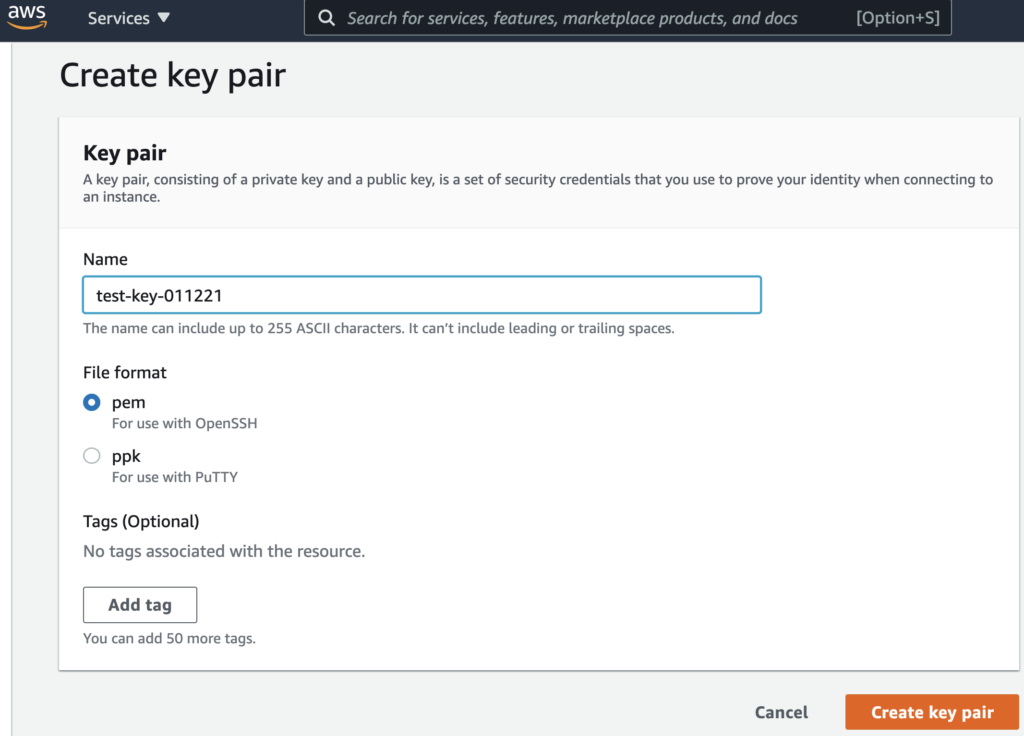
Upfront, to run the below playbook:
$ ansible-playbook -i localhost \ aws-ec2-launch-example.yml \ --vault-countersign-file ~/.vpass.txt The contents of our aws-ec2-launch-case.yml:
--- - hosts: localhost connection: local name: AWS EC2 Launch Case gather_facts: false vars_files: - creds.yml vars: key_name: examination-key-011221 instance_type: t2.micro region: us-west-2 image: ami-0841edc20334f9287 count: 2 tasks: - name: launch EC2 instance(s) amazon.aws.ec2: key_name: '{{ key_name }}' instance_type: '{{ instance_type }}' aws_access_key: "{{ aws_access_key }}" aws_secret_key: "{{ aws_secret_key }}" region: '{{ region }}' prototype: '{{ image }}' wait: aye count: '{{ count }}' register: result - debug: var: result The lines to highlight above are the last iii:
1. The register: effect line captures everything the amazon.aws.ec2 module gets back from AWS and puts it in a variable. This allows usa to practice things like pass the result to other parts of the playbook… impress it to stdout… or do annihilation else you tin can recall of doing with its text:
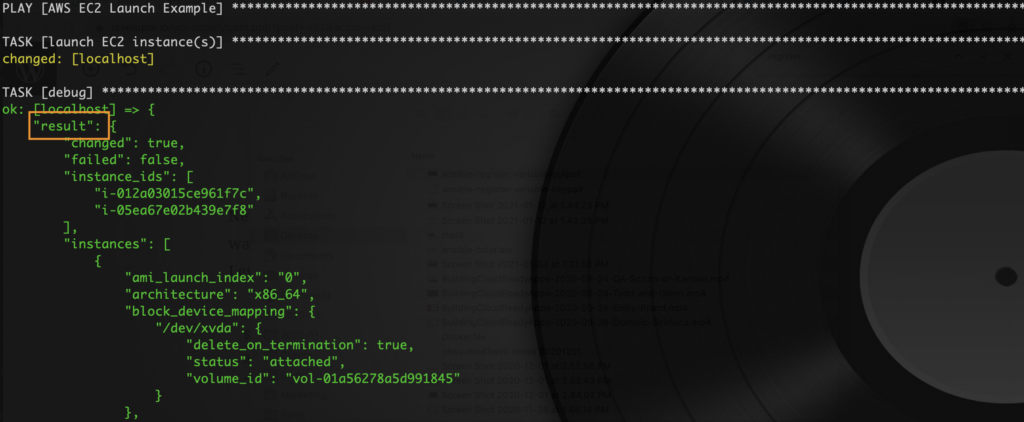
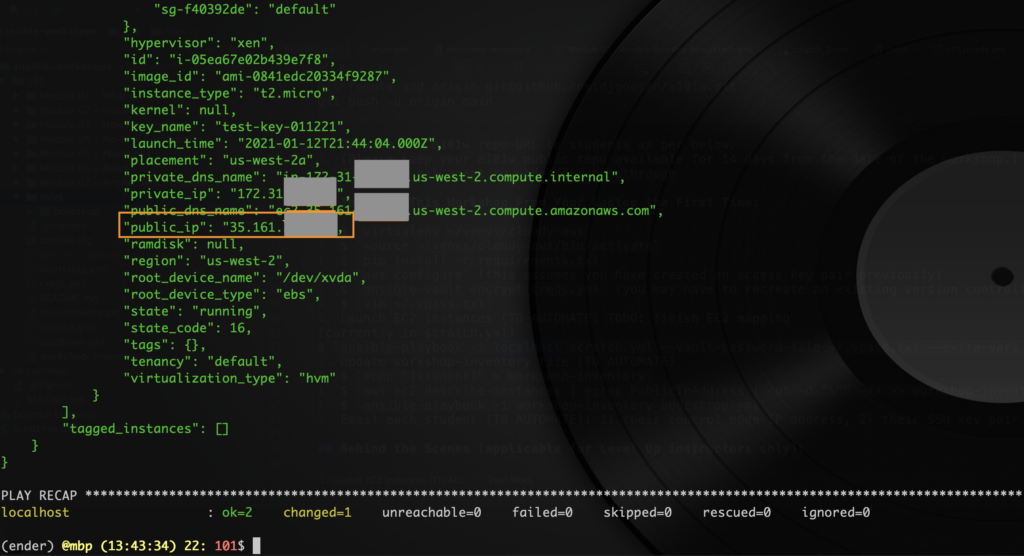
2 & 3. The subsequent debug chore volition print the data in the var: result to stdout. This allows for further parsing of details similar public IP addresses:
Equally an bated: What'due south one reward of variabilizing fifty-fifty inputs like instance_type, that you may not await to change as frequently? Well, across the fact that it makes for a more generic and reusable playbook (pretty much ever a proficient thing), using variables lets you trivially inject different key-value pairs via methods similar ansible-playbook's builtin -e EXTRA_VARS, –actress-vars EXTRA_VARS flag at runtime (eastward.g., instance_type=m4.large). This definitely beats having to constantly modify your underlying infrastructure code files, especially in real world scenarios where you're sharing your code repos with the entire team.
In conclusion, existence able to annals variables in your Ansible playbooks makes working with and transforming whatever chore output pretty much trivial. And mastering this fundamental infrastructure lawmaking blueprint will also bring you one stride closer to your longterm goal of automating basically everything in sight!

When Do Registered Variables Run In Ansible,
Source: https://levelupla.io/ansible-register-variables/
Posted by: benallyackles.blogspot.com
0 Response to "When Do Registered Variables Run In Ansible"
Post a Comment